
The Framework
The intelligence beneath human behavior.
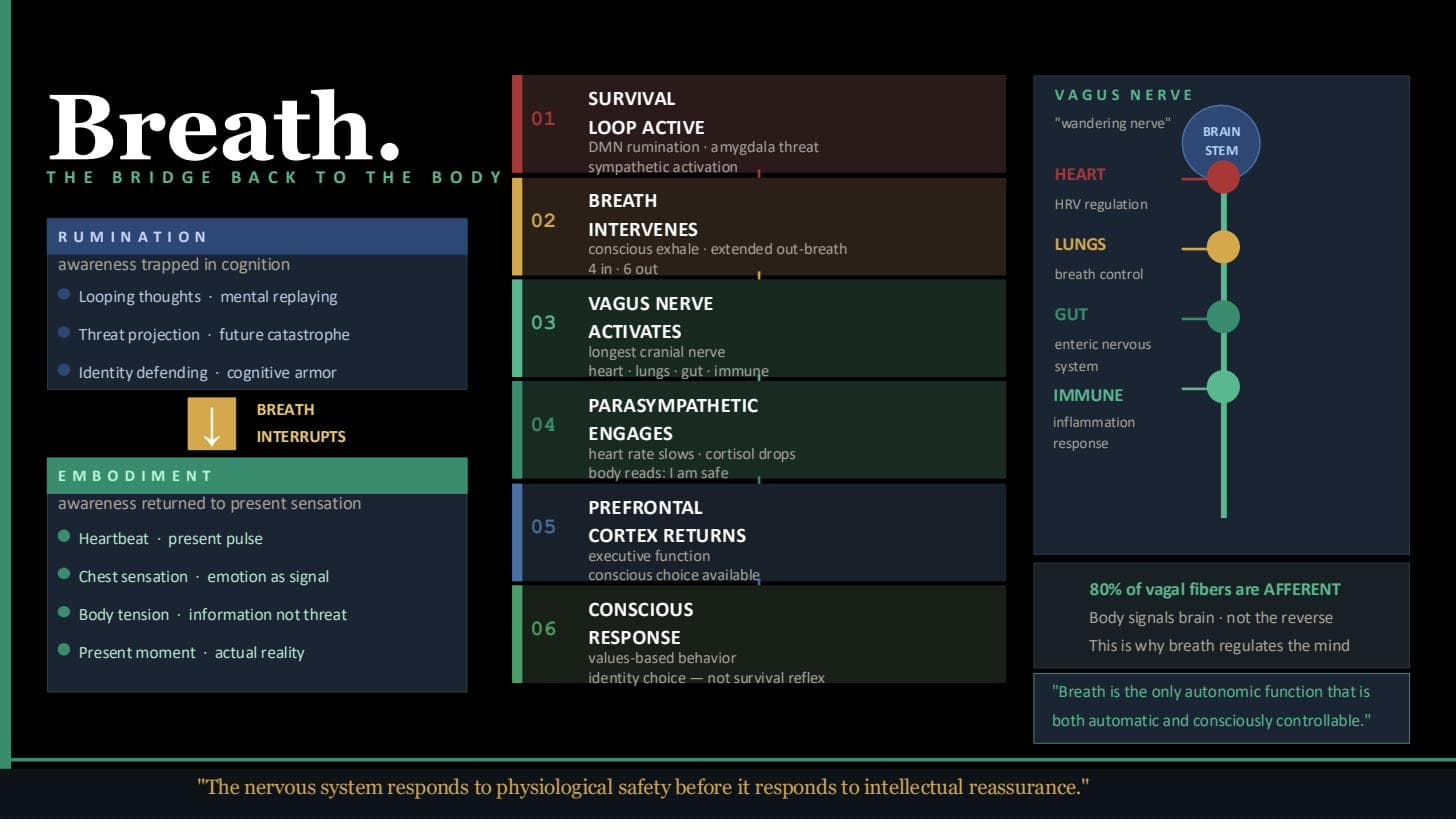
Identity Alchemy™ reveals the hidden nervous system and identity patterns shaping behavior under pressure. The RYZR Regulation Method™ bridges awareness back into the body through breath, nervous system regulation, and behavioral integration — restoring access to conscious response, emotional flexibility, and intentional behavior in real time.
The Process
Three phases. One complete behavioral rewire.
Pattern Recognition
Most people live inside their patterns without ever recognizing them. The same relational dynamics. The same emotional reactions. The same leadership stress responses repeating across different environments.
Pattern Recognition makes the unconscious visible. It reveals the behavioral loops, emotional defaults, and nervous system patterns operating beneath awareness — not as judgment, but as data.
When a pattern has a name, it loses its invisibility. And when it loses its invisibility, it loses some of its authority. This is where change begins.
Identity Mapping
Identity Mapping places behavioral patterns inside the architecture of the Identity Alchemy™ framework.
Across 30 archetypes organized within four domains — Connection, Protection, Validation, and Control — individuals begin seeing how their nervous system organizes around safety under pressure.
This is not a personality label. It is a Behavioral Intelligence map — revealing protection strategies, stress responses, relational tendencies, leadership patterns, and the gap between regulated and adaptive states. Not preference. Patterning.
Alchemical Integration
Insight without integration is just information.
Alchemical Integration is where pattern recognition becomes operational in real time. Using the RYZR Regulation Method™, individuals learn to recognize the activation, yield instead of react, zone in on the pattern beneath the behavior, and respond from the regulated self instead of the conditioned one.
The goal is not to erase the pattern. Survival strategies are a form of intelligence — designed to protect. The work is learning how to respond with awareness instead of automatic protection.
Domain 01 — Pattern Identity
The four ways the nervous system learns safety.
Identity patterns are not personality types. They are adaptive survival strategies shaped by conditioning, relationships, and lived experience.
Each domain reflects a different way the nervous system organizes around safety under pressure.
Connection
Safety through attunement, harmony, and relationship.
These identities prioritize connection, emotional awareness, and the needs of others to reduce relational threat.
The nervous system learns:
“If connection is maintained, I am safe.”
Protection
Safety through withdrawal, containment, and self-protection.
These identities survive through emotional guarding, self-reliance, suppression, or invisibility.
The nervous system learns:
“If I protect myself, I stay safe.”
Validation
Safety through achievement, approval, and recognition.
These identities connect self-worth to productivity, performance, expectations, and external affirmation.
The nervous system learns:
“If I succeed, I will finally feel worthy.”
Control
Safety through predictability, management, and certainty.
These identities seek safety through structure, anticipation, emotional control, and managing uncertainty.
The nervous system learns:
“If I can control it, I can survive it.”
Domain 02 — Nervous System Mapping
The four primary nervous system response styles shaping behavior under pressure.
Every identity pattern organizes around a dominant survival response — the automatic way the nervous system moves toward safety when threat, stress, conflict, or emotional pressure is perceived.

Fawn
Nervous system responds by attuning to others and prioritizing connection to feel safe — often merging with others' emotional states, over-accommodating, and suppressing internal needs to preserve harmony.
Freeze
Nervous system suppresses emotional expression and holds tension internally to maintain control — withdrawing, going quiet, and enduring rather than releasing. Activation is managed through containment.

Fight
Nervous system externalizes activation — moving into control, confrontation, or action to restore safety. These identities respond to threat by engaging rather than withdrawing, often before they've chosen to.

Flight
Nervous system activates into constant movement and productivity to avoid stillness and internal discomfort. Safety is equated with motion — slowing down feels like falling behind, or worse, feeling.
The Archetypes
30+ identity patterns. One Behavioral Intelligence map.
Every individual carries a unique hierarchy of behavioral patterns shaped by nervous system conditioning, adaptation, and survival learning.
These archetypes reveal protection strategies, stress responses, communication tendencies, relational dynamics, and leadership patterns under pressure.
Not personality types. Behavioral patterns.
Connection
- The Caretaker
- The Peacekeeper
- The Mascot
- The Mediator
- The Emotional Caretaker
- The Emotional Activator
Protection
- The Strong One
- The Invisible One
- The Scapegoat
- The Responsibility Holder
- The Withdrawn Self
- The System Stabilizer
- The Quiet Stabilizer
- The Diminished Self
- The Shut Down Protector
- The Passive Stabilizer
Validation
- The Achiever
- The Pleaser
- The Obligator
- The Golden Child
- The Overachiever
Control
- The Hyper Attuned
- The Guarded Analyzer
- The Intellectualizer
- The Rebel
- The Protector
- The Fixer
- The Armored Protector
- The Vigilant Protector
- The Controlled Protector
The RYZR Regulation Method™
A real-time framework for interrupting conditioned survival patterns.
The RYZR Regulation Method™ helps individuals recognize and regulate automatic nervous system responses in real time — not hours later in reflection, but in the moment the activation is happening.
This is the process of moving from unconscious reaction into intentional response.
Recognize
Notice the activation as it happens. Recognize the emotional shift, behavioral pattern, or protection strategy coming online in real time.
Awareness is the first interruption.
Yield
Pause the automatic reaction. Instead of immediately reacting, create space for awareness, regulation, and conscious choice.
Zero In
Identify what is operating beneath the behavior. What pattern is active? What is the nervous system attempting to protect?
Respond
Choose the response from the regulated self instead of the conditioned pattern. This is where awareness becomes behavioral change in real time.
You can't change a pattern you cannot see.
The assessment helps reveal what's been shaping your behavior beneath awareness.
15 minutes · No account required